
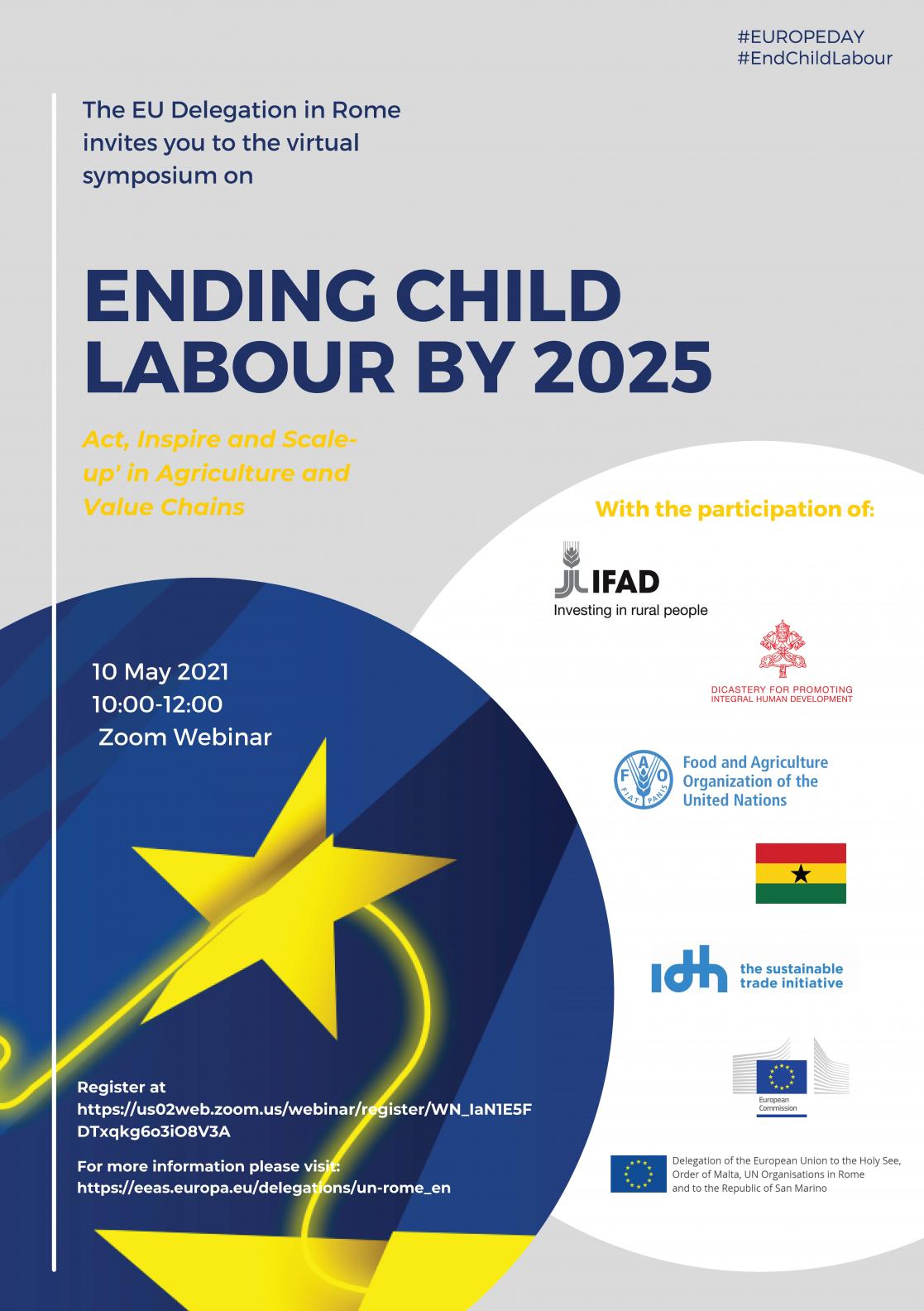
Europe Day 2021 Symposium – Monday 10 May

Those who wish to register:
- Registration page
- Consent form for processing of personal data
-
-
Please note that the event will be livestreamed on the EU Delegation’s YouTube Channel
2021 has been designated as the International Year of the Elimination of Child Labour. As we enter into the Decade of Action to Deliver on the Sustainable Development Goals, it will be a pivotal year in working towards our target SDG 8.7 of ending child labour and all its forms by 2025.
Sustainable agriculture, together with fisheries and aquaculture, remain the key driver for poverty eradication and sustainable development. The EU is committed to develop agricultural value chains, which benefit the poor by taking advantage of the opportunities offered by local and global markets to create decent jobs and value added. The EU considers value chains as a major channel for agriculture development from “farm to fork.”
On the occasion of Europe Day 2021, the Delegation of the European Union wishes to contribute to the elimination of child labour by organising a symposium focusing on three guiding questions:
- What challenges are we facing in child labour in agriculture and value chains and how could we address them?
- How can partnerships throughout the whole value chain make a difference for children and their families?
- How to accelerate action towards the achievement of SDG 8.7? How do we get from where we are now to where we want to be by 2025?
The concept note in annex explains the background of the event and contains the agenda.
AGENDA
|
10:00 - 10:05 |
Event opening, Ms Jacki Davis, Moderator |
|
10:05 - 10:10 |
Welcoming remarks by H.E Alexandra Valkenburg, Ambassador of the European Union |
|
10:10 - 10:15 |
Video message of the Secretary General of the European External Action Service, Stefano Sannino |
|
10:15 – 10:45 |
Introductory remarks by each panellists |
|
H.E. Gilbert F. Houngbo, President, International Fund for Agricultural Development on ‘Sustainable livelihoods to end child labour’ |
|
|
H.Em. Cardinal Peter Turkson, Prefect of the Dicastery for Integral Human Development on ‘Advocacy of the Holy See and pastoral work against child labour’ |
|
|
H.E. Hon. Ignatius Baffour-Awuah, Minister of Employment and Labour Relations, Ghana on ‘Experiences and lessons learnt from Ghana’ |
|
|
Ms Els Haelterman, Head of International Partnerships and Fundraising at IDH The Sustainable Trade Initiative, Beyond Chocolate Partnership on ‘the added value of multistakeholder partnerships in the cocoa sector’ |
|
|
Mr Máximo Torero Cullen, Chief Economist, UN Food and Agriculture Organisation on ‘Child labour in agriculture’ |
|
|
Mr Martin Seychell, Deputy Director General of International Partnerships, European Commission |
|
|
10:45 – 10:50 |
Launch of the video on the Clear Cotton Project in Pakistan – Protecting children from pesticides |
|
10:50 – 11:50 |
Interactive panel discussion with a Q&A session |
|
11:50 - 11:53 |
Video message from Laura Pausini, Grammy and Golden Globe Award-winning singer and songwriter, Academy Award nominee |
|
11:53 - 12:00 |
Closing remarks |
OUR SPEAKERS:


FIND OUT MORE:
2021 has been designated as the International Year of the Elimination of Child Labour, and it is time to re-double collective efforts, renew international commitments and scale-up actions to consign child labour into history.

Credit: EU Natali Prize 2020
The European Union is firmly committed to achieve SDG Target 8.7 ending child labour in all forms by 2025. While the number of children in child labour has declined by 94 million since 2000, the pace of progress has slowed down significantly between 2021 and 2016 (ILO 2018). The impact of the Covid pandemic would compromise possible improvements. Together with its partners, the EU Delegation in Rome decided to organise a virtual symposium to raise awareness on the importance of the persistence of child labour.
What is child labour?
While child labour is a serious violation of human rights and the right to education, it is important to remember that not all work done by children should classified as child labour.
The International Labour Organisation defines child labour a work that deprives children of their childhood, their potential, and their dignity, that is harmful to their physical and mental development. It refers to work that (i) is mentally, physically, socially or morally dangerous and harmful to children; and/or (ii) interferes with their schooling.
Child labour is a complex issue with deep political, and socio-economic roots. When addressing these problems one needs to develop a holistic and comprehensive approach, recognising that child labour is both a cause and consequence of poverty, inequality, discrimination, social exclusion, and lack of access to education.
Child labour in numbers
The latest Global Estimates indicate that 152 million children – 64 million girls and 88 million boys – are in child labour, accounting for almost 1 in 10 of all children worldwide. Almost half of the 152 million children are aged 5-11 years (ILO 2017).
About 71% child labourers are in agriculture, including fishing, forestry, and farming. Agriculture is the only sector where child labour has increased, having an additional 10 million child labourers between 2012 and 2016. FAO identifies household poverty and food insecurity as the main driver of child labour in agriculture (FAO 2020).

Credit: FAO
Child labour is exacerbated by crisis situations arising from conflicts and human-made or natural disasters. Some 535 million children (almost 1 in 4 children in the world) live in conflict-affected countries, while children comprise more than half of the 65 million people presently displaced by war (UNICEF 2016). The onset of the Covid-19 is also expected to increase the level of child labour. Temporary school closures during the pandemic have affected more than 1 billion children in over 130 countries, resulting in learning deficits for students, particularly from poor rural households. Studies project that a 1 per cent rise in poverty can lead to at least 0.7 per cent increase in child labour. (UNICEF 2020).
What are the key drivers of child labour?
The key drivers of child labour include:
- rising household poverty, low and uncertain income, and unemployment;
- limited decent work opportunities, low wages, difficult transitions to work;
- inadequate or lack of social protection systems: lack of or no access to health insurance and unemployment benefits;
- inadequate legislative framework and weak legal enforcement and protection of fundamental rights;
- reduced access and barriers to free education, poor quality schooling;
- traditions and socio-cultural norms;
- increased social vulnerability and socio-economic inequalities,
- labour exploitation of informal and home workers;
- irregular labour, and migration.
The European Union’s approach
The European Commission set out a ‘zero tolerance policy on child labour’ for every new trade agreement with the highest standards of climate, environmental and labour protection. The aim is to bring sustainable development to the centre of the bilateral trading relationship. Accordingly, the EU is currently reviewing its due diligence legislation throughout the supply chain on human rights, environmental impacts, as well as child labour. The legislation would affect partnerships agreements with producing countries and set out time-bound-measurable and enforceable roadmaps.
EU external assistance also contributes to reduce child labour through various thematic and geographic programmes, bilateral and regional cooperation.
What the EU does to end child labour?
- Helps strengthen the capacities of partner countries in better designing and improving the regulatory and legislative framework and policy implementation. This also facilitates the effective implementation of the ILO Conventions.
- Supports employment and labour protection policies and strengthens community prevention mechanisms and social support structures that are instrumental to improve family livelihoods.
- Supports local governments, public service providers, and other relevant stakeholders to take effective action to combat child labour. The EU also supports the programmes of international organisations.
- Promotes strategic and comprehensive interventions addressing the root causes of child labour in value chains, in particular through projects in cocoa, cotton, garment, mining and fisheries sectors.
- Promotes youth employment and partnerships in the area of traineeships and apprenticeship systems to provide young people with the skills required to ease their transition from education to the labour market.
- Promotes access to quality and inclusive education by reaching out to marginalised children and those in vulnerable situations.
In the framework of the EU Strategy on the Rights of the Child, the European Commission will:
- allocate 10% of humanitarian aid and funding to education in emergencies and protracted crises;
- maintain a zero tolerance policy for child labour;
- support efforts towards affordable and accessible healthcare, healthy nutrition, psycho-social support, education and leisure activities;
- seek to address domestic and gender-based violence, and harmful practices against women and girls;
- strengthen integrated child protection systems;
- support the training of justice professionals on child-friendly justice;
- work with the Council of Europe to implement their 2010 guidelines on child-friendly justice;
EU normative framework
- EU Strategy on the Rights of the Child
- EU Action Plan on Democracy and Human Rights
- EU Guidelines on the Promotion and Protection on the Rights of the Child (2017)
- EU Charter of Fundamental Rights
- EU Directive on the protection of young people at work (94/33/EC)
- EU Council Guidelines on Children and Armed Conflict (2003)
- European Consensus on Development
- European Commission – Political Guidelines 2019-2024
Child labour in agriculture and value chains
Sustainable agriculture, together with fisheries and aquaculture, remain the key driver for poverty eradication and sustainable development. The agricultural sector holds great potential to save lives and contribute to livelihoods, support rural households, provide decent employment and alternatives to child labour.
Partnerships are critical to foster the participation of UN and other organizations in global efforts to eliminate child labour in agriculture, but also to build capacities of key actors in the agricultural sector to address child labour issues in national policies and programmes.
The EU is committed to develop agricultural value chains, which benefit the poor by taking advantage of the opportunities offered by local and global markets to create decent jobs and value added in particular for youth and women. The EU considers value chains as a major channel for agriculture development from “farm to fork.”
COTTON
Cotton is one of the world’s most widely grown crops and most important agricultural commodities. Directly and indirectly, cotton production and the textile and garment sectors are responsible for the economic growth, employment and food security of millions of farmers and families across Africa, Asia and Latin America. Therefore, child labour is inherently connected to systemic challenges, which do not only impede the fundamental principles and rights to work but also the sustainability of the supply chain.

Credit: Child weaver in carpet production industry, Lahore district, Pakistan - copyright: ILO, credit: M. Crozet
From the most recent Global Estimates of Child Labour of 2017, there are 73 million children involved in hazardous work, that directly endangers their health and safety. Hazardous work can cause death, serious illness or injury, permanent disability or psychological damage, as a direct consequence of poor safety and health standards, exploitation or abuse.
Through the CLEAR Cotton project, the EU works together with the ILO and FAO to eliminate child labour in all its forms and forced labour in the cotton, textile and garment value chains in target producing countries: Burkina Faso, Mali, Pakistan and Peru.
The project combines an integrated area-based and value chain approaches to cooperate with governments, social partners, local farmers and communities, and international buyers. It seeks (i) to strengthen national legislation, policies and programmes to address the basic needs and rights of children and to combat child labour and forced labour in the cotton, garment and textile sector, and (ii) supporting local governments, public services providers, and other relevant stakeholders to take effective action to stop child labour and forced labour in target cotton growing districts and communities, as well as garment and textile factories.
Hazardous work in cotton production is among the worst forms of child labour, as children are exposed to harmful pesticides (as indicated by ILO Convention 182 on the Worst Forms of Child Labour, which was universally ratified in 2020). In implementing the EU funded CLEAR Cotton project in Pakistan, the ILO and FAO is working with cotton growing communities to build capacities around Occupational Safety and Health (OSH). The project is helping protect children from harmful pesticides in Southern Punjab. Training tools have been developed to raise awareness about harmful pesticides used in the growing of cotton. They include a booklet and adapted visual guide called “Protect Children from Pesticides!” for the Pakistani context and translated into Urdu. The guide shows how children are exposed to pesticides, what the health risks are, why children are particularly vulnerable, and what can be done to reduce those risks.
COCOA
Cote d’Ivoire and Ghana account for 70% of the world’s cocoa production. Cocoa is a major contributor to export earning, and it is the main source of livelihoods for almost 7 million farmers.
The European Union is the world's largest importer of cocoa, accounting for 60% of world imports (ITC 2020). Therefore, it is of utmost importance to bring sustainable development to the centre of the bilateral trading relationship.
Building on the political priorities under the European Green Deal and the Commission’s ‘zero tolerance’ approach to child labour, in 2020, the EU engaged in partnership with Ghana and Cote d’Ivoire and launched the EU Sustainable Cocoa Initiative, a ‘multistakeholder dialogue for sustainable cocoa’, addressing the three dimensions of sustainability.
Building on the success of the dialogues in 2020, and considering the EU’s role as a policy and global standard setter, in 2021, the European Commission announced a EUR 25 million package of technical assistance and budget support for Cote d’Ivoire, Ghana and Cameroon. The EU will adopt a coordinating role and work closely with a wide variety of actors – national authorities, private sector, EU Member States, civil society, and other relevant organisations at the national, regional and global level - to support a framework for sustainable cocoa production, comprehensively addressing the economic, social and environmental dimensions of sustainability, including child labour, farmers’ income, deforestation, fair trade and investment.

Credit: ShutterStock
BACKGROUND READINGS:
European Commission, Directorate-General for International Partnerships: Thematic articles on child labour
The Clear Cotton initiative
ILO, The Clear Cotton Project Factsheet:
ILO, The Clear Cotton Project Brochure:
ILO, Clear Cotton Project on Child Labour and Forced labour
European Commission, DG International Partnerships, ‘Clearing Cotton from Child Labour’,12 June 2020
Sustainable Cocoa Initiative
European Union Multistakeholder Dialogue For Sustainable Cocoa – Report: (September 2020)
Further readings:
FAO Framework on Ending Child Labour in Agriculture (2020)
FAO – Eliminating child labour in agriculture with social protection (2020)
FAO - Eliminating child labour in fisheries and aquaculture
FAO - Ending child labour - The decisive role of agricultural stakeholders
FAO - Handbook for monitoring and evaluation of child labour in agriculture
FAO - Addressing hazardous child labour and reducing risks posed by hazardous pesticides
EU Strategy on the Rights of the Child
EU Strategy on the Rights of the Child - Factsheet
EU pledges at the IV Global conference on the Sustained Eradication of Child Labour
European Commission, FAO Video (2019): “What did you dream of becoming when you were a child?”
ILO Ending Child Labour by 2025: A Review of Policies and Programmes, Geneva, 2018


