
Green Transition
The Green Transition Section of the EU Delegation to China facilitates and supports policy dialogue and exchange of information, as well as implementation of cooperation activities between the European Union and the People’s Republic of China, with a view to addressing global climate, energy and environmental challenges and promoting sustainable pathways of development; the section is also responsible for transport and maritime affairs, which are key policy areas under the European Green Deal.
Presented by the Commission on 11 December 2019, the European Green Deal sets the goal of making Europe the first climate-neutral (net-zero GHG emissions) continent by 2050 to tackle climate change and environmental degradation. It is the strong policy basis on which the EU engages with the People’s Republic of China.
The section engages mostly with the Government of the People’s Republic of China, but also with civil society, including NGOs and experts, think tanks and academics, and business representatives. The section works closely with colleagues from the Embassies of EU Members States present in China.
-
Image
 Copyright
European Union, 2026
High-Level Environment and Climate Policy Dialogue on 14 July 2025 (p1)
-
Image
 Copyright
European Union, 2026
High-Level Environment and Climate Policy Dialogue on 14 July 2025 (p2)
-
Image
 Copyright
European Union, 2024
Executive Vice President Šefčovič with Vice Premier Ding at the 2024 High Level Environment and Climate Dialogue.
Green Transition
The green transition is now a core subject of international relations and has grown into a very active pillar of bilateral relations between the EU and China. On the occasion of the EU-China Summit in Beijing on 24 July 2025, a Joint Statement on Climate was adopted, the first statement adopted at a bilateral summit in the 2020s. [picture of our leaders]
The High-Level Environment and Climate Dialogue (HECD) is the highest political format of bilateral engagement on these issues, covering broad fields, including climate, environment, energy and oceans, inter alia.
The most recent meeting of the HECD took place in Beijing on 14 July 2025. It was co-chaired by First Vice Premier Ding Xuexiang on the Chinese side, and Executive Vice President Teresa Ribera of the European Commission on the EU side, accompanied by EU Commissioners Wopke Hoekstra, Jessika Roswall and Dan Jørgensen.
Both parties discussed their respective domestic climate, energy and environmental policies, as well as bilateral cooperation and multilateral negotiations. They reconfirmed that the HECD is an important platform for exchange of views and cooperation and for advancing implementation and ambition. The Press Readout of the 6th HECD is available here.
Based on the experience of the success of the Kunming-Montreal Global Biodiversity Framework (GBF), and later of the Biodiversity Beyond National Jurisdictions (BBNJ), a previous EU co-chair of the HECD, then EVP Timmermans, once stated that “when the EU and China are united, there is a chance of success; when they are not, there is a guarantee of failure”.
Indeed, bilateral EU-China cooperation aims importantly at contributing to global governance, including in implementing the United Nations Framework Convention on Climate Change (UNFCCC), the Paris Agreement and the Kunming-Montreal Global Biodiversity Framework, inter alia.
The EU is also represented in the China Council for International Cooperation on Environment and Development (CCICED), a high-level advisory body that submits policy recommendations to China’s State Council, with two representatives: Kurt Vandenberghe, Director-General for Climate Action, and former Director-General Jos Delbeke.
The EU also supports the EU-China Think Tank Engagement on Green Governance project, which seeks to further implement a multi-stakeholder initiative to strengthen long-term think tank engagement on green governance between China and the EU, among other people-to-people exchanges.
-
Image
 Copyright
European Union, 2026
On 2 February 2026, Commissioner Roswall co-chaired in Brussels the 3rd EU–China Water Policy Dialogue with Minister for Water Resources Li Guoying. (p1)
-
Image
 Copyright
European Union, 2026
On 2 February 2026, Commissioner Roswall co-chaired in Brussels the 3rd EU–China Water Policy Dialogue with Minister for Water Resources Li Guoying. (p2)
-
Image
 Copyright
European Union, 2026
On 17 June 2025, Commissioner Roswall co-chaired in Brussels the 10th EU-China Environment Policy Dialogue with Minister Huang Runqiu of China’s Ministry of Ecology and Environment.
-
Image

Commissioner Sinkevicius and Minister Li Guoying at the 2nd Meeting of EU-China Water Policy Dialogue.
-
Image

European Commissioner for Environment, Oceans and Fisheries Virginijus Sinkevičius talking with China’s Minister of Ecology and Environment Huang Runqiu.
Environment
Protection of the environment is a key pillar of the EU Green Deal, but also a shared concern for the EU and the People’s Republic of China. Cooperation between the EU and China has been going on for many years, creating trust and close relations. A large number of programmes are feeding this bilateral cooperation, allowing exchange of views and experience between experts on both sides.
The Environment Policy Dialogue has been held at ministerial level since 2003. On 17 June 2025, Commissioner Roswall co-chaired in Brussels the 10th EU-China Environment Policy Dialogue with Minister Huang Runqiu of China’s Ministry of Ecology and Environment.
The dialogue focused on key areas such as biodiversity conservation, implementation of the Kunming-Montreal Global Biodiversity Framework, negotiations for an international plastic pollution agreement, environmental pollution control, and multilateral environmental governance.
Biodiversity
Both sides acknowledge that close EU-China cooperation was instrumental to deliver the global agreement on the Kunming-Montreal Global Biodiversity Framework (GBF). At the 10th Environment Policy Dialogue, which was held on 17 June 2023, the EU and China agreed to cooperate to keep the political momentum to implement the Global Biodiversity Framework. Both sides discussed ways to enhance exchanges of best practices on protecting and restoring biodiversity on the ground in the EU and China.
Circular economy
For both the EU and China, circular Economy is an important political priority. Cooperation between the European Union and China on circular economy was strengthened in 2018 with the signature of a Memorandum of Understanding on Circular Economy, which governs all bilateral activities implemented in this field. The MoU was extended for five years in 2023. The two sides held two high-level policy dialogues on circular economy and jointly developed a circular economy roadmap to support the implementation of the MOU.
On 14 July 2025, Commissioner for Environment, Water Resilience and a Competitive Circular Economy Jessika Roswall co-chaired in Beijing the 2nd EU-China High-Level Policy Dialogue on Circular Economy with a counterpart of China’s National Development and Reform Commission.
Plastic pollution
Beyond already existing bilateral cooperation and projects, the EU and China have agreed to increase exchanges as an internationally legally binding instrument to end plastic pollution is being negotiated.
Deforestation
The EU and China have been cooperating in the framework of the Bilateral Cooperation Mechanism (BCM) on Forest Law Enforcement and Governance and Trade (FLEGT), with the Chinese State Forestry Administration, to tackle illegal logging and associated trade through domestic measures (information, legal frameworks and policies) and through joint work with other countries, including in Southeast Asia and Africa, to stem the trade in illegally logged timber.
With the adoption of the EU Deforestation Regulation, the EU intends to intensify and broaden its exchanges with China beyond illegal logging.
Wildlife protection
Both sides agreed at the 4th HECD in July 2023 to further enhance bilateral cooperation to protect wildlife.
Through technical projects and ahead of COPs, the EU also engages with the National Forestry and Grassland Administration on wildlife protection and implementation of the Convention on International Trade in Endangered Species of Wild Fauna and Flora (CITES).
Water
EU-China cooperation on water started in the mid-2000s and further evolved with the launch of the China Europe Water Platform (CEWP) at the 6th World Water Forum in 2012. The Platform, coordinated by two Secretariats hosted by EU Member States - on a rotating basis - and by the Chinese Ministry of Water Resources (MWR).
In 2017 the EU and China signed a Memorandum of Understanding stepping up cooperation on water with the establishment of the EU-China Water Policy Dialogue, as one of the Ministerial-level Dialogues under the EU-China Summit framework, allowing for a deeper exchange of information and providing policy steer to the work of the Platform.
On 2 April 2019, EU Commissioner Mr. Karmenu Vella and Mr. E Jingping, Minister of Water Resources of China co-hosted the 1st EU-China Water Policy Dialogue. On 25 September 2023, Commissioner Sinkevicius co-chaired in Beijing the 2nd EU-China Water Policy Dialogue with Minister for Water Resources Li Guoying.
On 2 February 2026, Commissioner Roswall co-chaired in Brussels the 3rd EU–China Water Policy Dialogue with Minister for Water Resources Li Guoying. The Policy Dialogue was followed by the 11th High-Level Dialogue of the China-Europe Water Platform (CEWP), hosted by Commissioner Roswall and chaired by the Portuguese Ministry of Environment and Energy and Chinese Ministry of Water Resources on 2 February, alongside a technical workshop taking place on the 3 February. Click here for the joint press release.
Besides bilateral cooperation, EU and China also reinforce water cooperation at international fora. In March 2023, the EU and China successfully co-chaired an Interactive Dialogue on ‘Water for Sustainable Development’ at the UN 2023 Water Conference held in New York. Build on that, both leaders agreed to explore opportunities for coordinated action at UN2026 Water Conference.
In 2024, the EU-China Cooperation on Water Project was launched by the European Commission to further support the activities of China Europe Water Platform and the overall EU-China cooperation on water in areas such as climate resilient river basin management, the water-energy-food-ecosystem nexus, circular water management, water resilience and water finance.
-
Image
 Copyright
European Union, 2024
Commissioner Hoekstra (right) and Minister Huang (left) signing the Memorandum of Understanding on ETS cooperation on the side of the 2024 HECD.
-
Image
 Copyright
European Union, 2023
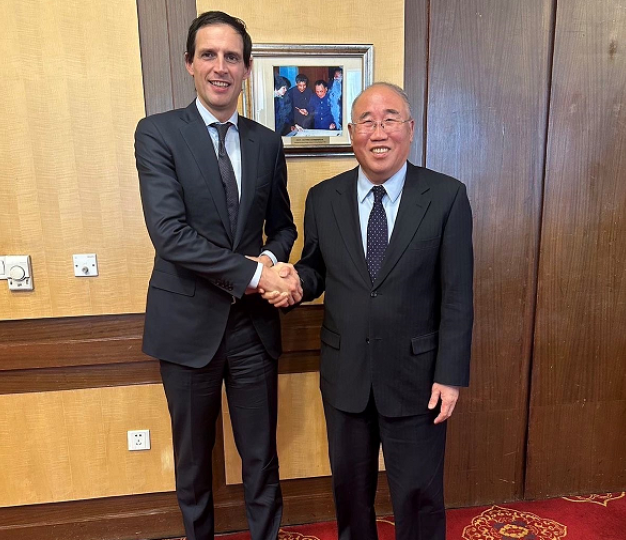
EU Commissioner for Climate Change Wopke Hoekstra (left) and China’s Special Envoy on Climate Change Xie Zhenhua (right).
-
Image

In a first visit to China since the creation of this dialogue, European Commission’s Director General for Taxation and Customs Union Gerassimos THOMAS met China’s Minister of Ecology and Environment Vice Zhao Yingmin on 16 November 2023, accompanied by representatives of several Chinese ministries (NDRC, Ministry of Commerce, State Taxation Agency).
Climate
The EU and China are key partners for global climate action and maintain a comprehensive bilateral cooperation on climate.
In 2005, the EU and China agreed to establish the Climate Change Partnership to provide a high-level framework for cooperation and dialogue on climate change policies, to exchange views on key issues in international climate change negotiations and to encourage low-carbon technology development and uptake.
In the following years, both the 2018 leaders' statement on climate change and energy and a Memorandum of Understanding (MoU) to enhance cooperation on Emissions Trading Systems (ETS) reinforced the targets of that partnership.
At the 1st EU-China High-Level Environment and Climate Dialogue in February 2021, both sides restated their commitment to work closely together, as well as to take leadership in pressing ahead of the international process and delivering the goals of the Paris Agreement.
EU Climate Commissioner Wopke Hoekstra visited Beijing and attended the 6th HECD on 14 July 2025. During the dialogue, both sides reiterated the importance of multilateralism and of reducing emissions and expressed a strong willingness to cooperate towards COP30. Both sides exchanged on the implementation of current NDC objectives. They also discussed their mitigation ambition under the new Nationally Determined Contributions (NDCs) due ahead of COP30 in Belém. Key future bilateral activities were also discussed: carbon markets, CBAM, finance for resilience, adaptation and just transition.
Emission Trading System (ETS)
The EU is sharing its experience of setting up its own ETS and encouraging China to strengthen its own carbon market as it is the most cost-efficient tool to curb emissions. The cooperation was initiated in 2014 through an EU-funded programme to support Chinese efforts in setting up and running an efficient national ETS, and has been a key component of EU-China climate cooperation to date.
On June 18, 2024, an updated MoU on ETS cooperation was signed in Brussels by EU Commissioner Hoekstra and Minister Huang (Ministry of Ecology and Environment), on the side of the HECD. The new text broadened the scope of the ETS partnership, reflecting a deepened cooperation between EU and China.
The 6th EU-China ETS Policy Dialogue between Director-General Kurt Vandenberghe of DG CLIMA and Vice Minister Li Gao of Ministry of Ecology and Environment took place in Shanghai on 24 September 2025. The dialogue exchanged the latest status and work plans for China and EU’s respective carbon markets and set the direction for EU-China ETS collaboration in the next steps.
The European Union and China worked closely with the COP30 Presidency Brazil on a Declaration on the Open Coalition on Compliance Carbon Markets, adopted in November 2025 at the World Leaders segment of the UN's Climate Change Conference – COP30. The Leaders' Declaration boosts the recognition of carbon pricing and market mechanisms as key tools to advance climate action globally and implement national climate plans, while the EU and China will work closely together, and other members of the Coalition, on the development and enhancement of compliance carbon markets and carbon pricing policies to enable progress and achieve the Paris Agreement goals.
Methane
While the EU encourages China to join the Global Methane Pledge, the two sides have also agreed on a bilateral cooperation, which started in December 2022.
In the past two years, the two sides carried out exchanges on the challenges and good practices in controlling and reducing methane emissions in the waste sector and also on coal mine mitigation policies and technologies.
Climate adaptation
While both sides have done a series of technical exchanges on climate risks and adaptation, the EU and China have agreed to intensify policy and experience exchanges.
Carbon Border Adjustment Mechanism (CBAM)
On 4 July 2023, then European Commission Executive Vice President Frans Timmermans and Vice Premier of the People's Republic of China Ding Xuexiang held the fourth EU-China High-Level Dialogue on Environment and Climate (HECD) in Beijing. Both sides agreed to create a dialogue on the EU’s Carbon Border Adjustment Mechanism (CBAM). The CBAM Implementing Regulation was then adopted by the European Commission on 17 August 2023 (more information).
In a first visit to China since the creation of this dialogue, European Commission’s Director General for Taxation and Customs Union Gerassimos Thomas met China’s Vice Minister of Ecology and Environment Zhao Yingmin on 16 November 2023, accompanied by representatives of several Chinese ministries (National Development and Reform Commission, Ministry of Commerce, State Taxation Agency).
A large public event dedicated to the EU’s CBAM was held during the visit to inform and listen to Chinese companies and other stakeholders. Since then, regular exchanges have been taking place between European and Chinese experts.
-
Image
 Copyright
European Union, 2026
On 14 July 2025, European Commissioner for Energy and Housing Dan Jørgensen and Administrator Wang Hongzhi of China’s National Energy Administration (NEA) co-chaired in Beijing the 12th EU-China Energy Dialogue in Beijing.
-
Image

On 12 October 2023, European Commissioner for Energy Kadri Simson and Administrator Zhang Jianhua of China’s National Energy Administration (NEA) co-chaired the 11th EU-China Energy Dialogue in Beijing.
Energy
The EU and China are jointly responsible for one third of the world's final energy consumption, thus sharing common interests and goals for advancing the green energy transition, while fostering energy security. This is where cooperation between the EU and China focuses. The energy transition is a prerequisite to successfully implement the Paris Agreement and to provide citizens with clean, sustainable and affordable energy.
On 14 July 2025, European Commissioner for Energy and Housing Dan Jørgensen and Administrator Wang Hongzhi of China’s National Energy Administration (NEA) co-chaired in Beijing the 12th EU-China Energy Dialogue. Both sides reaffirmed that the overarching objective of China-EU energy cooperation is to expedite the global transition to clean energy, with full consideration for ensuring energy security with the aim of addressing the challenges of global climate change. Both sides agreed to sustain cooperation on advancing various aspects of the clean energy transition as discussed during the Dialogue.
The EU-China Energy Dialogue was established in 1994 and strengthened in April 2019 at the 8th Dialogue meeting, when the EU and China signed the Joint Statement on the Implementation of EU-China Energy Cooperation. Later in May 2019, the EU-China Energy Cooperation Platform (ECECP) was launched in Beijing.
The ECECP has been established as a practical tool to support and operationalise the Energy Dialogue and to deliver on the specific objectives of the EU-China bilateral energy cooperation, in line with the EU’s Energy Union, the Clean Energy for All Europeans initiative and the Paris Agreement on Climate Change. Over the past years, the Platform has provided a venue for numerous conferences and dialogues and generated comparative studies and reports. The Platform mobilizes a wide range of energy players in China and in the EU. More information on the EU-China Energy Cooperation Platform can be found here.
-
Image
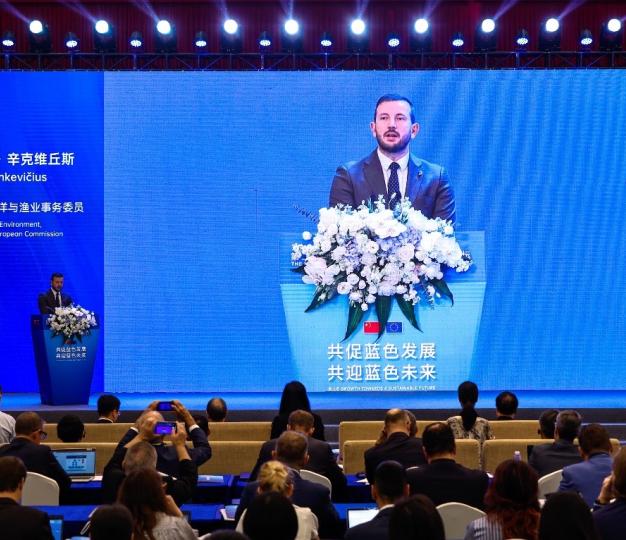
On 23 September 2023, the 2nd EU-China Blue Partnership Forum for the Ocean was held in Shenzhen.
-
Image

Commissioner Sinkevičius talked with Minister Wang Guanghua before the High Level Dialogue on Ocean Governance.
Oceans, maritime affairs and fisheries
EU cooperation with China has a long history and is managed on the EU side by the European Commission Directorate General for Maritime Affairs and Fisheries (DG MARE).
It is structured around three High-Level Dialogues (HLDs): the HLD on Ocean Affairs, the HLD on Fisheries and the HLD on Law of the Sea and Polar Affairs.
Blue Ocean Partnership
EU and China’s longstanding cooperation on ocean affairs led to the signature of the EU-China “Blue Partnership for the Oceans” in 2018, which underlines that two of the world’s largest ocean economies will work together to improve the international governance of the oceans in all its aspects, including by combating illegal fishing and promoting a sustainable blue economy.
On 23 September 2023, the 2nd EU-China Blue Partnership Forum for the Ocean was held in Shenzhen. Follow this link for the speech by Commissioner Sinkevičius.
Ocean Governance
The EU and China both recognise that the ocean is a common good and that ocean governance, including fisheries, is a shared challenge and responsibility that calls for closer international cooperation and global action.
Since 2010, the EU and China held six meetings of the High-Level Dialogue on Ocean Governance to address challenges related to oceans. The latest dialogue took place in Shenzhen on 22 September 2023 and was co-chaired by the European Commissioner for the Environment, Oceans and Fisheries Virginijus Sinkevičius and China’s Minister of Natural Resources Wang Guanghua.
Fishery and IUU
Achieving sustainable fisheries and a sustainable development and use of the ocean is a huge challenge worldwide. Both the EU and China are responsible as flag, port and market states, and as members of Regional Fisheries Management Organisations, to fight Illegal, unreported and unregulated (IUU) fishing. In order to enhance cooperation on fisheries, the European Commission and China’s Ministry of Agriculture and Rural Affairs established a High-Level Dialogue on Fisheries. The sixth meeting of the Dialogue took place on 21 September 2023 in Shenzhen and was co-chaired by Ms. Charlina Vitcheva, the Director General for Maritime Affairs and Fisheries of the European Commission and Mr. Liu Xinzhong, the Director General of the Fishery Bureau of China’s Ministry of Agriculture and Rural Affairs.
The High-Level Dialogue is supported by the EU-China Working Group on Illegal, unreported and unregulated fishing, which ensures regular exchanges on what represents one of the biggest threats faced by oceans.
Law of the Sea and Polar Affairs
With the High-Level Dialogue on Law of the Sea and Polar Affairs, the European Commission and China’s Ministry of Foreign Affairs exchange on questions related to the Law of the Sea and on polar affairs, which include protection of the high seas or the establishment of marine protected areas (MPAs), including in the Antarctic in the framework of CCAMLR Convention. The last meeting of the High-Level Dialogue took place in Beijing on 26 September 2023.
The effective implementation of the BBNJ agreement (Agreement under the United Nations Convention on the Law of the Sea on the Conservation and Sustainable Use of Marine Biological Diversity of Areas beyond National Jurisdiction), also referred to as the High Seas Treaty, which entered into force on 17 January 2026, is a priority for the EU. Cooperation between the EU and China is essential in this regard.
Transport
Transport is a core element of the EU-China relationship, contributing to advance people-to-people relations, investment and trade.
The EU Delegation works closely with its counterparts in China, with the EU Member States, with EU companies and with the EU-China Chamber of Commerce to improve transport connectivity, ensure success, as well as to resolve any issue.
While air connectivity plays the central role for people-to-people exchanges, shipping, and more recently rail cargo, serve our bilateral trading relationship.
In December 2024, the EU-China Aviation Partnership Project (APP), launched in 2016 and funded by the Service for Foreign Policy Instruments (FPI) of the European Commission marked the completion of its second phase. Follow this link for more information.
Maritime transport
The EU maintains a continuous dialogue with China on issues related to maritime transport under the EU-China Maritime Transport Agreement. Among them, exchanges and cooperation on decarbonisation of maritime transport is high on the agenda. The 18th Implementation Meeting of the Agreement (Maritime Transport Dialogue) took place in May 2024.
Sustainably and Smart Mobility
The European Commission’s Sustainable and Smart Mobility Strategy, adopted on 9 December 2020, sets targets for the next 10-30 years, aimed at enabling the EU transport system to achieve green and digital transformation, and to become more resilient when facing future crises.
The EU and China face similar challenges related to transport, notably pollution, accidents and congestion. There is potential for cooperation to stimulate decarbonisation and modernisation of the world transport and mobility system.